
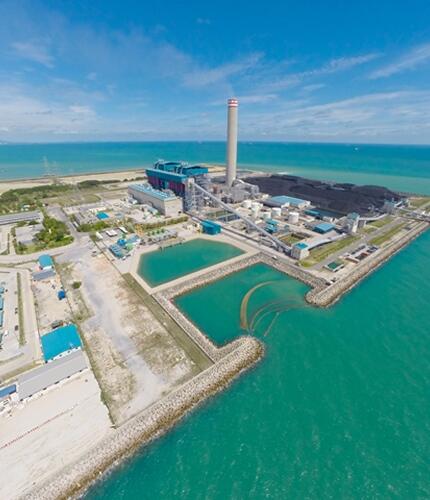
Air Impact Reduction Measures
Hot gases and pollutants from combustion pass through multiple pollution control systems before being released into the atmosphere:
Electrostatic Precipitator (EP) System
Four sets of Outdoor Four Field EP units are installed (2 sets per 700 MW generating unit), capable of capturing fine particulate matter with over 99% efficiency.Sea Water Flue Gas Desulfurization (Sea Water FGD) System
Seawater is used as an absorbent to efficiently remove sulfur dioxide (SO₂) from hot gases, achieving up to 98% efficiency.Low-NOx Combustion System
The boiler is designed with a Tangential Fire Single Vortex combined with Low-NOx Burners and a Separate Overfire Air system to limit oxygen levels and reduce combustion chamber temperature, thereby reducing NOx formation by up to 60%.200-meter High Flue Gas Stack
The 200-meter high flue gas stack is designed to facilitate the dilution and dispersion of pollutants at high atmospheric levels, preventing the accumulation of pollutants at ground level.
Strict control of dust dispersion at all risk points:
Enclosed Conveyor Belts: Coal is transported by a conveyor system fully enclosed with metal sheets along its entire length.
Water Spray System for Moisture Addition: Automatic water spray nozzles are installed at the ship unloader, coal transfer points (Transfer Towers), conveyor belts, and the coal yard.
Windbreak Wall: A 6-meter high, 450-meter long windbreak wall is constructed on the south side of the coal yard to resist wind forces and reduce dust dispersion.
Bag Filter System: Two Bag Filter units are installed at the Screen House before coal is fed into the Boiler Bunker.
Transparent and Verifiable Monitoring System (Continuous Environmental Monitoring)
BLCP continuously discloses data and monitors air quality through 3 main systems:
CEMS (Continuous Emission Monitoring System): Equipment is installed to continuously measure the concentration of particulate matter, SO₂, NOx, temperature, flue gas velocity, and oxygen within the exhaust stack 24 hours a day.
4 Community Air Quality Monitoring Stations: Ambient Air Quality monitoring stations are installed in communities around the power plant, namely Wat Takuan, Map Ta Phut School, Mueang Mai Map Ta Phut, and PTT Staff Housing, to measure TSP, PM-10, SO₂, NOx, and wind direction.
- ► Installation of low NOx burners to reduce nitrogen oxide emissions
- ► Installation of Electrostatic Precipitator (ESP) for dust collection
- ► Installation of Flue Gas Desulphurization (FGD) system for sulfur dioxide removal
- ► 200-meter high chimney stack
- ► Particulate matter 43 mg/m³ vs. the Pollution Control Department standard of 120 mg/m³ — 64% better
- ► Sulfur dioxide (SO2) per EIA at 262 ppm vs. the standard of 320 ppm — 18% better
- ► Nitrogen oxides (NOx) 241 ppm vs. the standard of 350 ppm — 31% better