Power Generation Technology

Clean Coal Technology

Clean Coal Technology

Clean Coal Technology is an approach to developing and improving the coal combustion process for maximum benefit, aiming to minimize environmental impact from particulates, SO₂, and NOₓ — covering pre-combustion, combustion, post-combustion, and coal conversion, divided into 4 main stages as follows:
Pre-combustion
Cleans the coal before use by removing impurities such as rock fragments, soil, and sulfur minerals, resulting in cleaner coal and reduced pollution in later stages.
• Methods used include:
  • Physical methods (e.g. screening and sizing)
  • Chemical methods
  • Biological methods
2. Combustion
Improves furnace and boiler efficiency for more complete combustion, reducing pollutants such as particulates, SO₂, and NOₓ.
• May include low-NOx burner technology or temperature-controlled combustion.
3. Post-combustion
Controls and removes pollutants generated by combustion before release into the environment, such as
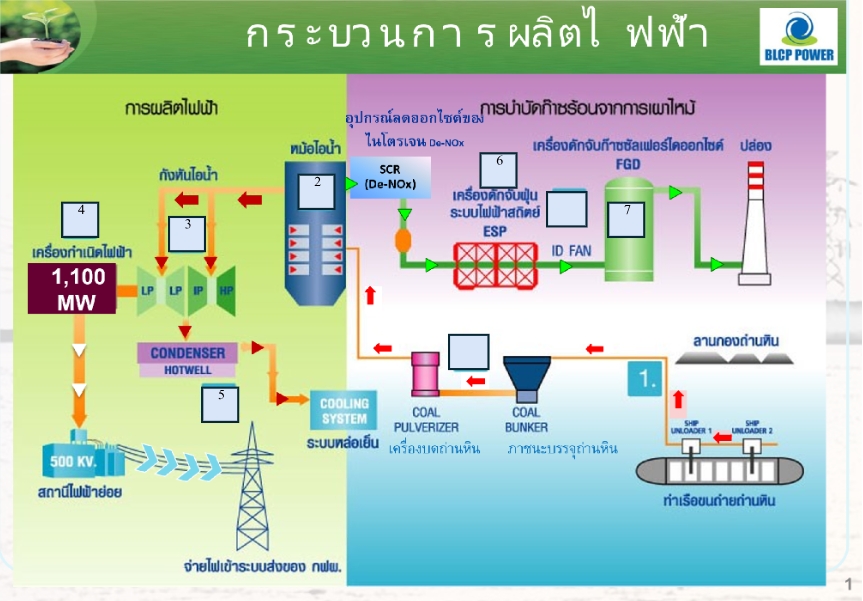
• ESP (Electrostatic Precipitator) to capture particulates
• FGD (Flue Gas Desulfurization) system to capture SO₂
• Selective Catalytic Reduction (SCR) to reduce NOₓ
4. Coal Conversion
Converts coal into other fuel forms such as gas (Coal Gasification) or liquid (Coal Liquefaction) to reduce emissions and use energy more efficiently.

Summary:

Clean Coal Technology is a key approach to balancing energy security with environmental care, focusing on reducing pollution at every stage of coal use, from upstream to downstream.
Plant Cycle Operating Steps

Plant Cycle Operating Steps

The power generation process uses circulating steam in a closed system, step-by-step as follows:

Condensation and Feedwater PreheatingSteam that has passed through the Low Pressure (LP) Turbine is condensed back into water in the Condenser Hotwell, using seawater as a coolant. The water is then pumped through the Gland Condenser and Low Pressure (LP) Heater to increase its temperature before being sent toDe-aeratorto remove dissolved gases from the water.
Water Feeding to BoilerHot water from the De-aerator is pumped by the Turbine Driven Boiler Feed Pump through the High Pressure (HP) Heater and Economizer to increase its temperature again, and then sent toBoiler Drum
High-Pressure Steam Generation 
    • Water in the Boiler Drum is circulated to absorb heat in the Boiler Furnace and then flows back into the Boiler Drum.

    • The Boiler Drum separates water and steam. The steam portion is then sent toSuperheater Coilto receive heat in the furnace until it becomes Superheated Steam with high temperature and pressure (a spray system is used to reduce heat if the temperature exceeds the set limit).

Steam Turbine Driving 
    • Superheated Steam (Main Steam) flows through Governor Control Valves into the High Pressure (HP) Turbine.

    • Steam that has passed through the HP Turbine is returned to the furnace for reheating (Reheat) and then sent to the Intermediate Pressure (IP) Turbine and Low Pressure (LP) Turbine, respectively, before being condensed back into circulating water in the system again.

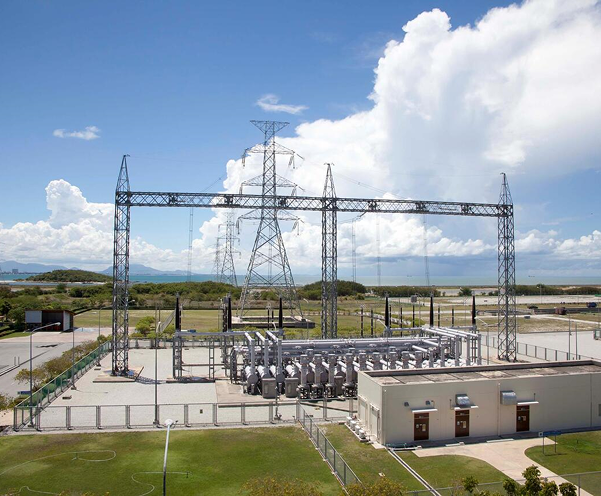
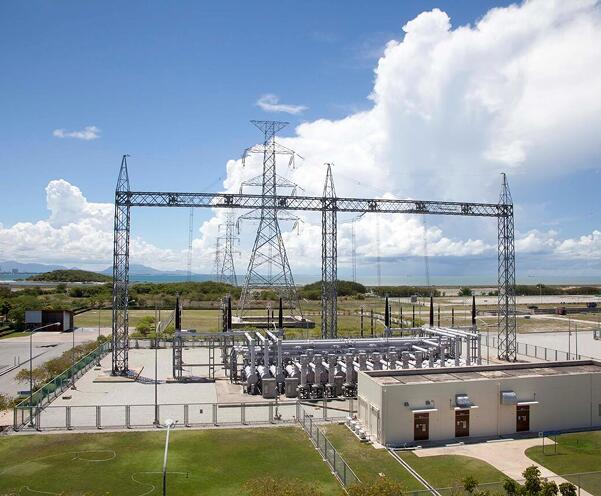
Electricity Generation and TransmissionThe steam turbine shaft is connected to the generator shaft. When the turbine rotates, electricity is generated, which is transmitted through conductors in the Isolated Phase Busduct to the transformer to step up the voltage to500 kVbefore being sent to the Switchyard for distribution into the Electricity Generating Authority of Thailand (EGAT) grid.

ติดต่อเรา
ติดต่อเรา
พร้อมให้บริการ

สวัสดีครับ! ยินดีต้อนรับสู่โรงไฟฟ้าบีแอลซีพี

มีอะไรให้ช่วยเหลือไหมครับ?

ตัวเลือกด่วน: